
The Inca Empire was one of the most fascinating and mysterious empires in history. It was a powerhouse that controlled a large area of South America, and its people were known for their impressive architectural feats and advanced technology
… But, the Inca Empire was more than that! It was full of impressive medical advances, religious rituals, and cruel punishments, among other curiosities.
The Incas were master road builders
Aside from Machu Picchu, the Incas constructed some of the best roads in the world to enhance communications in an empire that stretched from Ecuador to Chile.
The empire had numerous roads linking all the latitudes of the empire. It was called the Qhapaq Ñan. The Inca road system was one of the most impressive feats of engineering in the world.
They were built for efficiency and were used for military purposes, as well as for trade and transportation. The roads were often built along mountain ridges, making them easy to defend. They were also built with drainage in mind so that they would not become muddy and impassable during rainy weather.
The chasquis or runners managed a successful postal service
The Inca civilization had many impressive achievements, one of which was its postal service. This system was used to deliver fresh fish daily to the emperor, despite being located at a high altitude in Cuzco.
The Inca empire was connected by runners. They were based on a network of relay runners who would transport packages from one station to the next. These runners were known as chasquis – and they were able to cover great distances in a short period of time. They could travel 200 miles per day. Moreover, they could send strategic communications to keep the Empire running smoothly.
Today, the Inca trail is a popular hiking route that follows the path of the ancient postal service. While it is no longer possible to send fish fresh from the sea to the emperor, visitors can still enjoy stunning views of the Andes Mountains while imagining what it was like to be an ancient Inca runner.
The Inca Empire had no currency or writing system
The Inca empire was a highly advanced civilization, albeit one that relied on oral tradition rather than written records. Despite having no currency or formal writing system, they were able to maintain complex trade networks throughout their vast empire.
This was due in part to their khipus, a system of knotted cords that were used to keep track of numerical data. The khipus could be used to record everything from the number of llamas in a herd to the amount of grain in a storage house. This allowed Incas to keep meticulous records of their trade transactions.
The Incas didn’t have private property
The Inca empire was built on the backs of its people. There was no private property, and all citizens were expected to contribute to the empire in some way. This system allowed the Inca to build one of the most advanced civilizations in the world.
It all belonged to the Inca emperor. But, he was almost obliged to allow his people to work and manage the lands to provide food and drink for his vast empire. Although there was no private property and everything belonged to the emperor. Practically speaking, everyone had to work on his plot of land and do his best not to lose it.
The Inca justice system was severe but effective – and crimes were often punished with extreme brutality
Photo by Eduardo Taco
The Inca Empire was built on a strict code of conduct, which was enforced by a complex system of laws and punishments. At the heart of this system were three simple principles: “Do not steal. Do not lie. Do not be lazy.” These three commandments formed the basis of Inca justice – and they helped to create a society that was ordered and fair.
The principle of “ Do not steal” was enshrined in Inca law, and anyone caught stealing was subject to severe punishment. The penalty for theft depended on the value of the stolen item… But it could range from a simple fine to execution. However, usually, the punishment for stealing is having the hands cut off.
Likewise, lying was also punishable by law, and perjury could lead to exile or even death. The Inca believed that honesty was essential for maintaining order in society, and they didn’t tolerate those who violated this principle.
Finally, the rule “Do not be lazy” was designed to keep people productive and working hard on their lands. The Inca economy depended on the collective labor of its citizens, and idleness was viewed as wasteful and counterproductive. Those who refused to work were often sentenced to hard labor such as stone quarrying or agricultural work.
They were experts in mummification, and many of their dead were preserved for centuries
One of the most impressive achievements of the Incas was their mastery of mummification. The Incas believed that the soul continued to exist after death – and they saw mummification as a way to ensure that the body would be preserved in a pure state. As a result, they took great care in embalming and wrapping their dead, using a variety of materials including llama fat and alcohol.
There are even cases where mummies were taken to battle, marriages, harvesting, and all kinds of ceremonies. That way, the the Incas could have a direct link between the living and their gods. So, older generations could be present in body and soul even though he had already passed away.
They made better trepanations than 18th-century Americans
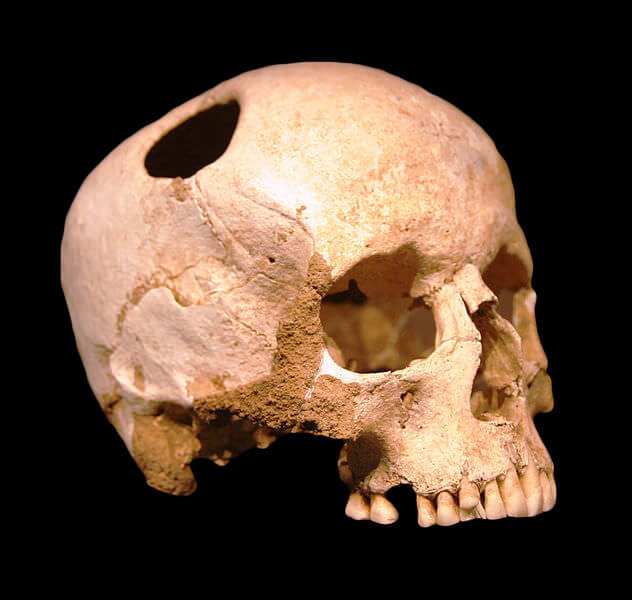
Photo by Mark Cartwright. Public domain
Trepanation is a surgical procedure in which a hole is drilled or cut into the skull. It was first performed by the ancient Incas, who believed that cured a variety of ailments and wounds. The Incas were so skilled at trepanation that their success rate was estimated to be as high as 90 percent.
In contrast, American doctors during the Civil War were less effective performing trepanation techniques, and patients often died from infection or bleeding. Even today, trepanation is considered a risky procedure and is not commonly performed unless the case truly justifies it.
Human sacrifices were a common occurrence in Inca society
Human sacrifice was a common practice in Inca society and often took place as part of religious ceremonies. Victims were typically drugged and then, killed by strangulation or decapitation.
Eventually, massive child sacrifices became common to ensure the prosperity of the entire community. When an important event such as a war or a natural disaster occurred, the Inca would often sacrifice children to appease the gods.
While some historians believe that the Inca only sacrificed a small number of children, others estimate that the empire may have sacrificed thousands of children over the course of its history. Whatever the reason, human sacrifice was an integral part of Inca culture and played a significant role in their religious beliefs.
Cranial deformation of babies was a common practice
The Incas had a strong political system that helped to keep conquered peoples united. This system included a strict hierarchy to control their vast empire for centuries.
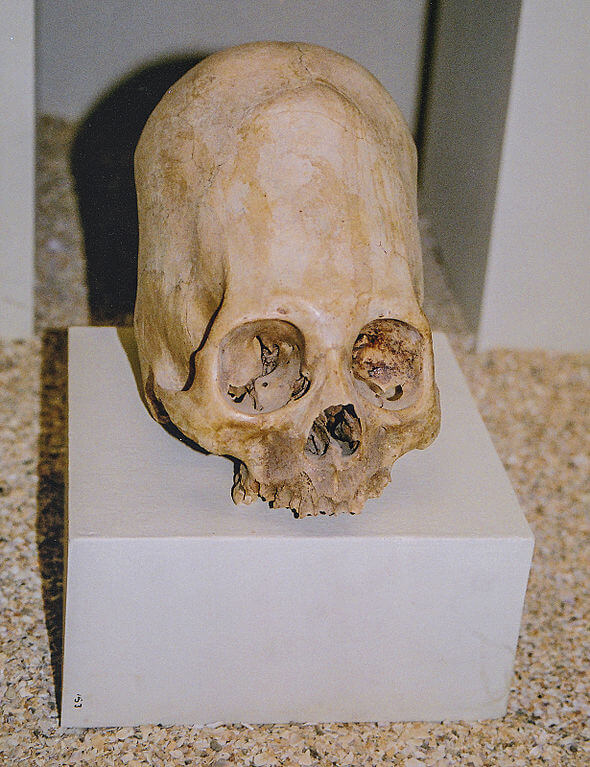
But, one lesser-known aspect of Inca culture is cranial deformation, It was a common practice among the Inca Empire– and one that had both cultural and religious significance. It is believed that the practice was used to mark social status, and infants’ skulls were intentionally misshapen to demonstrate their social status.
Skull of a human head very long in Peru Inca culture by Peter van der Sluijs. Public domain
The practice of cranial deformation began in infancy when bandages or wooden boards were used to shape the head. As the child grew, these devices would be tightened, resulting in a permanent change to the shape of the skull. While cranial deformation may seem strange to us today, it was an important part of Inca culture and played a significant role in their beliefs and practices.
The cruelty of the Inca civil war weakened the empire
The Inca Empire was one of the largest empires in the world at its peak. At its height, it included parts of present-day Ecuador, Peru, Bolivia, Chile, and Argentina. However, by the time the Spanish arrived in 1532, the empire was in decline.
One of the main reasons for this decline was the civil war that tore the empire apart in the late 15th century. The war was fought between two brothers, Huascar and Atahualpa, who were both vying for the throne. The conflict quickly turned brutal, with each side committing atrocities against civilians and prisoners of war. Thousands died in the fighting, and many more were displaced as cities and villages were destroyed.
Massacres were a regular occurrence and the population was gradually decimated by warriors who supported the Huascar or Atahualpa and conquered new territories. As a result, the Inca Empire never recovered from the damage caused by the civil war – and it eventually fell to the Spanish conquistadors.
Featured image: Photo by Marcelo Camargo Santos
